Building & Floor Selection
Using Mappedin SDK for React Native with your own map requires a Pro license. Try a demo map for free or refer to the Pricing page for more information.
Floor Selection
When mapping a building with multiple floors, each floor has its own unique map. These are represented by the Mappedin.Floor class, which are accessed using Mappedin.MapData.getByType('floor'). The currently displayed Floor can be accessed using MapViewControl.currentFloor.
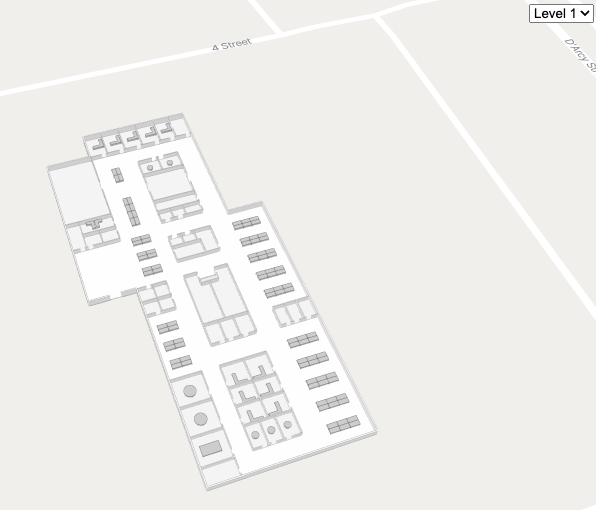
Changing Floors
When initialized, MapView displays the Mappedin.Floor with the elevation that's closest to 0. This can be overridden by setting Mappedin.TShow3DMapOptions.initialFloor to a Mappedin.Floor or Mappedin.Floor.id and using it in the MapViewProps.
- Declarative
- Imperative
<MapView
  options={{
    initialFloor: 'm_123456789',
  }}
  mapData={{
    key: "mik_yeBk0Vf0nNJtpesfu560e07e5",
    secret: "mis_2g9ST8ZcSFb5R9fPnsvYhrX3RyRwPtDGbMGweCYKEq385431022",
    mapId: "660c0c3aae0596d87766f2da",
  }}
>
</MapView>
// Setting the initial floor to Floor.id 'm_123456789'.
const mapView = await show3dMap(
    document.getElementById('mappedin-map') as HTMLDivElement,
    mapData,
    {
        initialFloor: 'm_123456789',
    }
);
The Mappedin.Floor displayed in a MapView can also be changed during runtime by calling MapViewControl.setFloor() and passing in a Mappedin.Floor or Mappedin.Floor.id.
// Set the floor to Floor.id 'm_987654321'.
mapView.setFloor(`m_987654321`);
Listening for Floor Changes
The Mappedin event system provides the ability to listen for floor changes on a MapView. The code below listens for the floor-change event and logs the new floor name to the console.
useMapViewEvent("floor-change", (event) => {
console.log(
  "Floor changed to:",
  event?.floor.name,
  "in FloorStack:",
  event?.floor.floorStack.name
);
});
Building Selection
Mappedin Maps can contain one to many buildings with each building having one to many floors. Each building has its floors organized into a Mappedin.FloorStack object. When multiple buildings are present, there are multiple Mappedin.FloorStack objects, one for each building. A Mappedin. FloorStack contains one to many Mappedin.Floor objects, each representing the map of each level of the building.
The Mappedin.FloorStack object is accessed by using MapData.getByType('floor-stack').
// Get the FloorStack object.
const floorStacks = mapData.getByType('floor-stack');
The Building & Floor Selection approach shown here displays a single Mappedin.Floor at a time and hides the other buildings while a building is selected. To display multiple floors at once, or to keep the surrounding building facades visible while exploring a building's interior, use Dynamic Focus instead. See the Dynamic Focus guide.
Determine If a Coordinate Is Inside a Building
The FloorStack object has a geoJSON property that can be used to determine if a coordinate is inside a building. Use Turf.js's booleanContains function to determine if a coordinate is inside a building.
The code below listens for a click event on the map and determines if the clicked coordinate is inside a building. If it is, the building name is logged to the console. If it is not, a message is logged to the console.
import booleanContains from "@turf/boolean-contains";
...

const buildings = mapData
  .getByType("floor-stack")
  .filter((fs) => fs.type === "Building");

// This demonstrates how to detect if a coordinate is within a building.
// For click events, this can be detected by checking the ClickEvent.floors.
// Checking the coordinate is for demonstration purposes and useful for non click events.
useMapViewEvent("click", (event: Mappedin.TClickPayload) => {
  let found = false;
  buildings?.forEach((building: any) => {
    if (booleanContains(building.geoJSON, event.coordinate.geoJSON)) {
      console.log("Coordinate is within building: ", building.name);
      found = true;
    }
  });
  if (!found) {
    console.log("Coordinate is not within any building");
  }
});